CLIENT
Walmart
MY ROLE
Senior AI Strategist
Created an AI Engine that reduced trend to shelf time from 6 months to 2 clicks, freeing up 200 hours of team time in one production cycle
Impact
Key Question: How might AI drastically reduce the time it takes to go from trend to shelf?
Creating an autonomous fashion engine
The problem
Walmart operates 4,000 stores across the US, refreshing fashion products every 30 days. Within a single production cycle, trend research consumed 50 hours, garment sketching took 71 hours, and design refinement added another 68 hours resulting in 200 hours of design work before a single product reached production.
Walmart wanted to figure out how they could increase the speed and efficiency at which garments are produced and scale that model to other areas of the business.

Phase 1: Discovery
The goal of this phase was to map the current process of making garments and understand key pain points experienced.
My role: I led this exploratory research phase, which included desk research, stakeholder interviews with Walmart's internal fashion teams and recruiting external subject matter experts across the industry to get a perspective outside of Walmart.

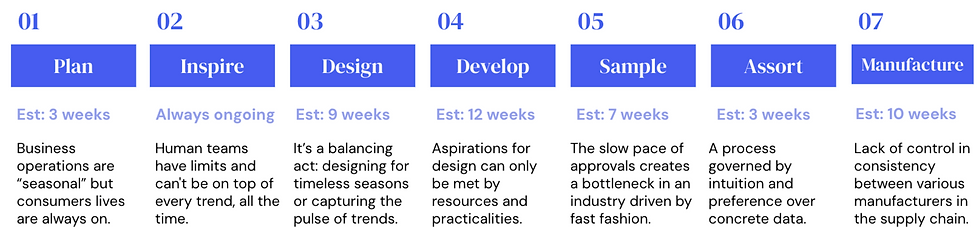
Interviews
Current process map and time spent
Key Insight: Designers spent 50 hours in a production cycle synthesizing trends. This process is fraught with human bias and constrained by our capacity to absorb and synthesize information. Even after all these hours they were never quite sure if they had looked at everything exhaustively.
Phase 2: Strategy & Build
The goal of this phase was to clearly define what process an AI engine should follow and what pieces of data does it need to perform the defined actions. We also defined what kind of human and agent input is required from one stage to the next to reduce noise and align with business priorities.
My role: I along with the team created the Task-Technology Fit Framework, evaluating each process stage for automation potential. I along with the team created synthetic agents such as design director, chief merchandiser, retail partner and created a set of instructions and business priorities per role so that they could provide feedback and enable decision making at every step along the way.

Autonomous engine process map, key data inputs and key outputs to be produced
Key ideas we introduced to ensure the outputs were truly valuable:
-
Always-on trends: Since we were no longer constrained by resources we identified more than 50 pieces of data that the engine should always be scanning for, for e.g. runway data, reddit conversations, interior design trends and many more
-
"Microdrops": One of the things we found in our interviews was that the front-end of the process is only as fast as the production times and that garment waste was one of the main problems they were looking to tackle. To navigate this we introduced the idea of a "microdrop" i.e releasing 10 new garments into stores every 2 weeks to get rapid-in-store feedback. This would solve both problems at once
-
Agentic employees: We created agentic employees such as design director, chief merchandiser and others that kept in mind the business' changing priorities. These agents provided feedback and go/no-go decisions from one stage to the next
-
Synthetic feedback from consumers: We introduced testing in the engine itself by creating synthetic personas of Walmart's diverse customers. These personas provide scores to the garments, ensuring only those moved froward that received a high score
Phase 3: Tailoring the engine
Once the core technology was validated, we built a usable front end and trained the engine specifically for one of Walmart's in-house fashion brands.
My role: I wireframed the user interface and ran lightweight usability tests with the Walmart fashion employees who would actually use it. I also built the engine's training data which meant translating intuitive human judgment (how a designer selects fabric and silhouette with season in mind) into structured logic a machine could follow.

Garment design screen


Microdrop selection screen

An example of the kind of moodboards the engine produced
The engine had picked up on the challengers trend shortly after the movie was released
In a blind study with 113 Walmart apparel customers the AI-generated garments are equally favoured when compared to human designs
Outcome
The time it takes from trend analysis to techpack production went from 6 months to 2 clicks
In a blind study with 113 Walmart apparel customers the AI-generated garments were equally favoured when compared to human designs

The garments that were tested against each other. All garments with stars are AI generated

AI generated designs(in blue) were rated on-par with human designs in terms of willingness to buy, trendiness and brand cohesion
Have something interesting we can work on together or just want to chat about a sticky problem?
Reach out to me!